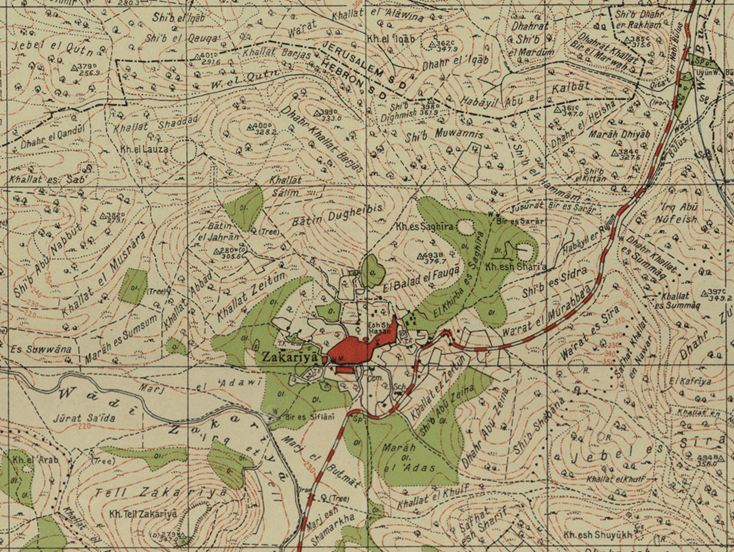
Map of Zakariyya and the surrounding villages, produced for the Survey of Palestine during the British Mandate era. Courtesy of Palestine Open Maps.
Zakariyya, along with the rest of Palestine, fell under British occupation in 1917–18, following the First World War, when many of the village’s male residents were conscripted by the Ottoman army. The British brought job opportunities, and prosperity increased, as did the population, with Zakariyya reaching perhaps around 2000 residents by 1948. However, so did oppression – residents of the village fought the British during the Palestinian uprising of 1936–39 – and the political and social developments which would tear Palestine apart in the Nakba.
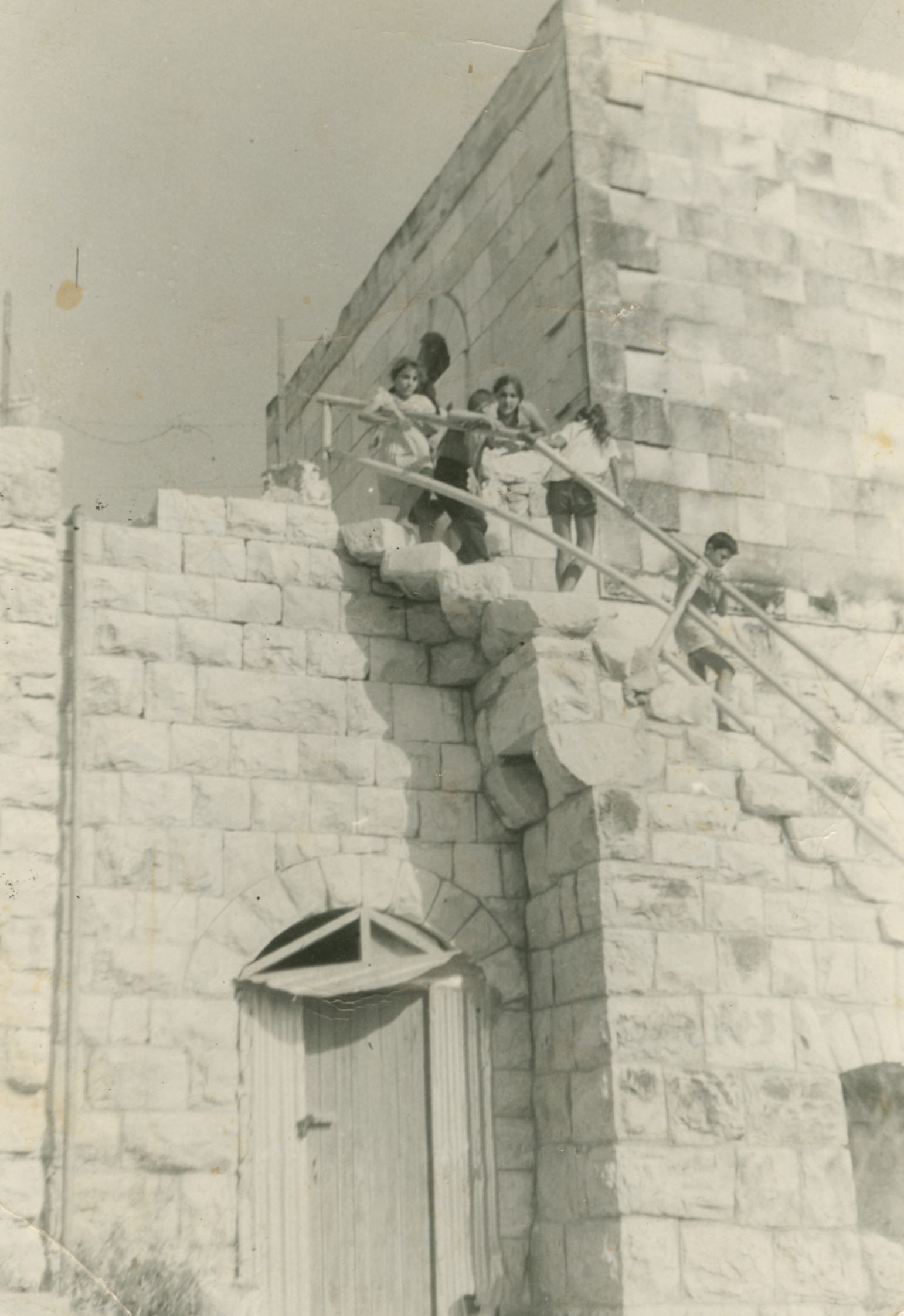
A house and children in Zakariyya during the British Mandate era, from the Zahira Zaqtan collection. Courtesy of the Palestinian Museum Digital Archive.
A positive development under British rule was the advancement of education. Previously, there had been no formal school in Zakariyya. Some children learned to read and write in Arabic in the mosque under the traditional kuttab system, instilling the knowledge and values of Islam. The skills learned here also had a practical benefit, with illiterate villagers from the surrounding area going to Zakariyya to have letters read to them.
In the 1920s or 1930s, a school was constructed in the village. The school initially taught grades one to six of the British Mandate curriculum; in 1947, villagers wrote to the governor of the Hebron district requesting an extra year of schooling. The first schoolteacher was named ʿAzmi ʿAbd al-Qadir Abu al-Saʿud, a member of the same prominent Jerusalem family as the mother of Palestinian political leader Yasser Arafat. After 1948, ʿAzmi emigrated and worked as a teacher elsewhere in the Arab world, like many Palestinians; he lived in Syria and Libya. A second teacher, Ishaq al-ʿAbbasi, came from Silwan near Jerusalem. As at all schools, the teachers of Zakariyya lived in fear of inspectors. One story tells how an infamously harsh inspector, ʿAfif al-ʿAtʿut, complained of the cobwebs he found in the school.
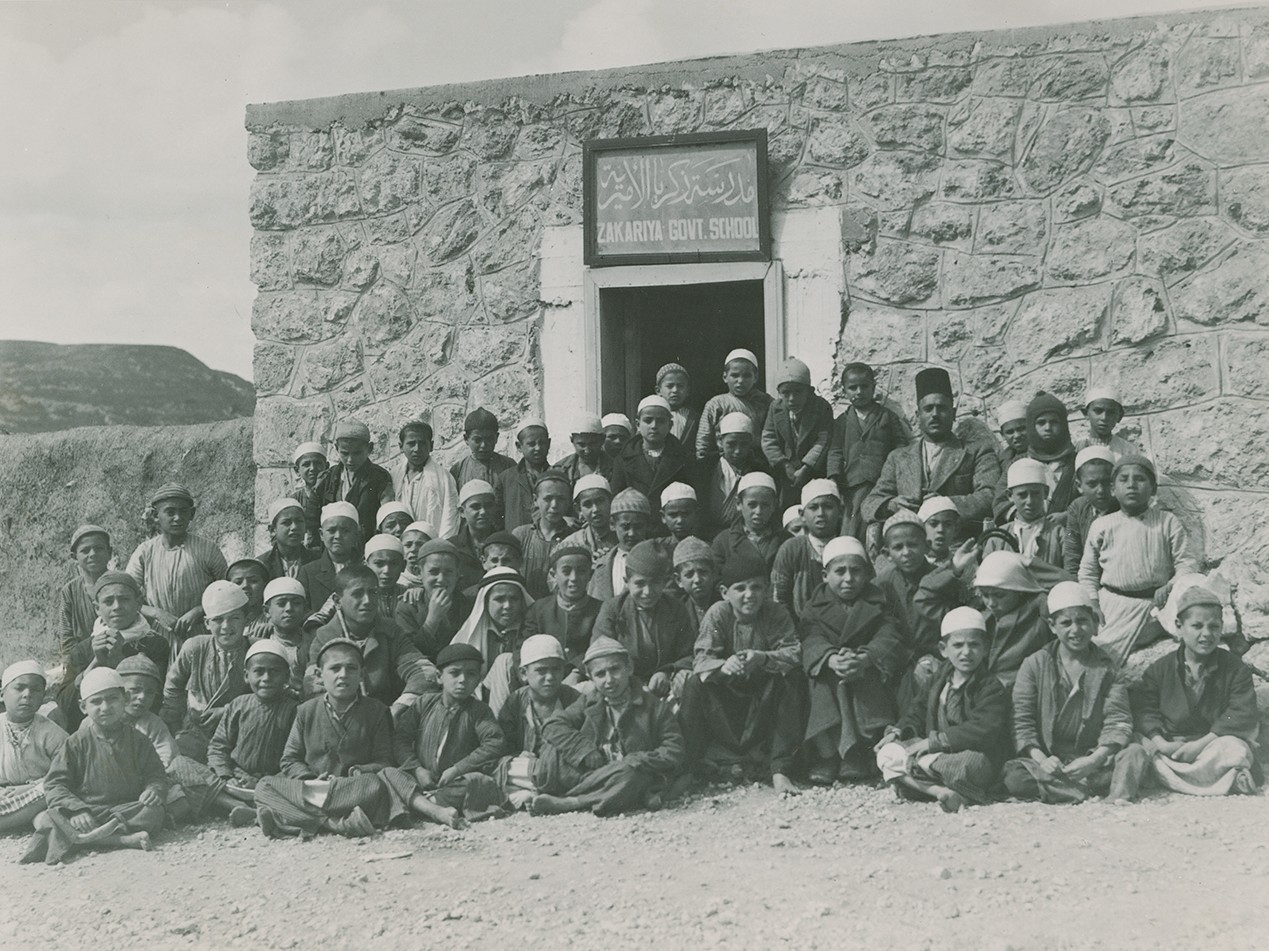
Zakariyya school during the British Mandate era. Courtesy of the Institute for Palestine Studies.
In late 1947, following the United Nations vote to partition Palestine between Arab and Jewish states, war broke out. Zakariyya lay well within the 43 percent of Palestine allocated by the UN for an Arab state. However, stories from around Palestine of forced expulsions and sometimes massacres of Palestinians demonstrated that Zionist militias – and after Israel’s declaration of independence on 15 May 1948, the Israeli army or IDF – had no intention of respecting the partition plan’s borders.
In October 1948, Zakariyya and other neighbouring villages, poorly defended by Egyptian soldiers, easily fell to the IDF. According to an account given by Yusra ʿAdawi, the mother of Sami al-Jundi, then aged 13, aircraft dropped leaflets warning the inhabitants of Zakariyya to leave their village, or face a similar fate to the residents of Dayr Yassin village, where over 100 villagers were massacred in April 1948. Ghassan Zaqtan writes “a fragile improvised line, composed of the sons of the mountain villages with their rifles, collapsed. The collapse was signalled by the fall of artillery shells on the village. Then the first armed Jewish forces started to arrive at the houses during dusk prayers, confirming the initial sign.”
The people of Zakariyya arduously trekked in search of relative safety. Yusra remembered that “We all walked southeast toward Hebron, hungry, thirsty, and exhausted … I cannot imagine how we survived. No food, no shelter.” Eventually, faced with starvation, some decided to return home, despite the danger. They found most of the homes undamaged, and about 200 villagers were able to resume their lives in Zakariyya. All the surrounding villages remained empty of their inhabitants, their fields now worked by new Jewish immigrants.
But life in the new state was difficult. Yusra explained
After a year, bandits began to arrive in Zakariyya in the middle of the night. They burst into people’s homes with sticks and clubs and began beating the young men. Night after night they returned, threatening people that soon worse would come. No one knew who these attackers were … We never found out for certain who sent them, but everyone felt they were connected to the Jewish paramilitary organizations. The entire village was scared.
So bad was the situation in Zakariyya, especially for children, that the self-appointed mukhtar, ʿAbd al-Hamid Abu Labban, had to ask for emergency food and medical assistance from the Israeli government.
Zakariyya residents did not know that their village was being discussed by Israeli authorities at the highest levels. In March 1949, an Interior Ministry official wrote that “in the village there are many good houses, and it is possible to accommodate in them several hundred new immigrants.” In January 1950, Yosef Weitz, the head of Israel’s so-called Committee for Refugee Affairs, met with the prime minister David Ben Gurion in the ethnically cleansed city of Tiberias, receiving his blessing for the eviction of the people of Zakariyya “without coercion.”
Long after the end of war in Palestine, on 17 May 1950, the 70 remaining families were driven away, in a well-documented and premeditated act of ethnic cleansing. The expulsion was facilitated by the collaboration of the mukhtar Abu Labban, whose reward was resettlement in the city of Ramla in Israel. Four Zakariyya families were allowed to go with him, and they and their descendants would receive Israeli citizenship. The other 65 families were driven to the border with the Jordanian-controlled West Bank, after they were offered paltry compensation for their land. The village of Zakariyya, heir to Beth Zachar and ʿAzekah, came to an end. For most of its inhabitants, the story continued in Dheisheh and other Palestinian refugee camps.
In May 1950, merely two weeks after the eviction, Zakariyya was settled by Jews, mostly from Kurdistan. It was renamed Zekharia, the Hebrew variant of the ancient name. Most of the Arab houses were demolished in the 1960s, but Zekharia eerily maintains the layout of the Palestinian village. Its entrance road is paved over the old cemetery. Five structures of old Zakariyya remain: three private residences, including a two-storey residence of the mukhtar, as well as the school and the mosque.
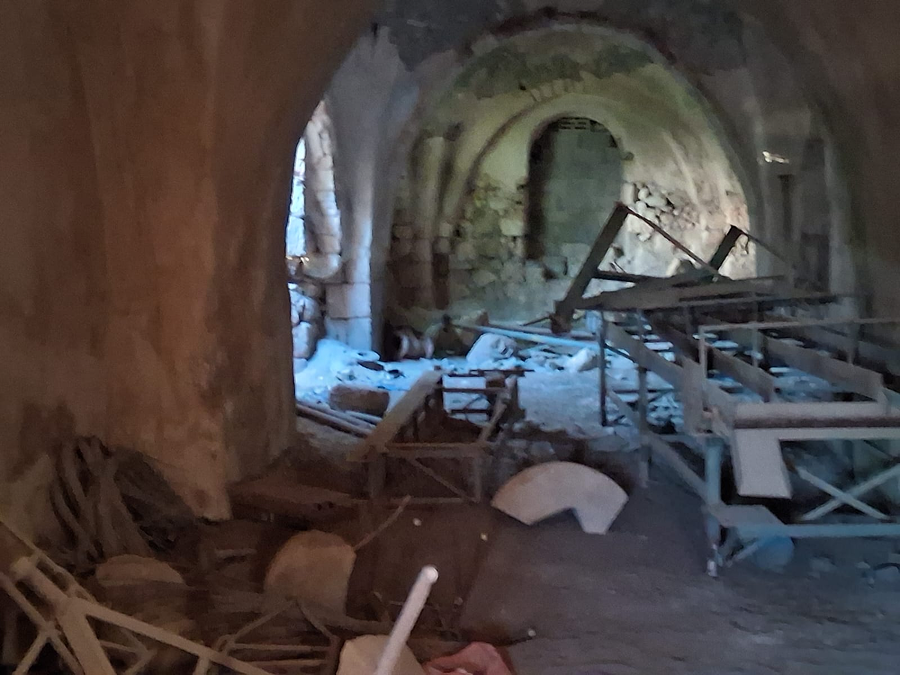
The dilapidated interior of Zakariyya mosque as of 2025. © Yossef Rapoport, 2025.
Palestinians from Zakariyya have never lost hope of return, however, and some have visited their home village when possible. In 2000, 150 refugees visited Zakariyya, holding prayers in the mosque for the first time in 50 years, attracting the curiosity – and from some, hostility – of Zekharia’s Israeli residents. More recent videos produced by
Shoruq Organization and
Zochrot show the appearance of Zakariyya/Zekharia today.
In 2010, Khader Salameh and his friend Mustafa ʿAdawi visited Zakariyya, writing with the weight of history on his shoulders:
The present reality shocks you, even though you know it. New houses, paved streets, cars of all models cramped up on the roadsides. We drag along until we reach the mosque of the village, and when you are there, you are overcome by the awe of history, despite the wretchedness of the place. Walls of disjointed masonry. A minaret on the verge of collapse, whose foundation has been exposed, either intentionally or by the passage of time, or both, and seems as if it is crying for us to help it so it remains lofty and proud as long as God wills it. …
Your imagination roams and you ask yourself how many times this minaret was destroyed, this mosque, this shrine – and how many times they were rebuilt and restored. You ask yourself how many languages changed around this place, this village that has endured since the third millennium BC to our present day, how many states and empires and raids swept over it in succession, how many languages were spoken, how many religions were put faith in, how many names were given to it. Yet it remained the village of Zakariyya, the shrine has remained a shrine, the mosque has remained a mosque, even if it has changed its function, for it is the site of worship to the Lord of Creation regardless of the name given to Him, and regardless of the language of prayer.