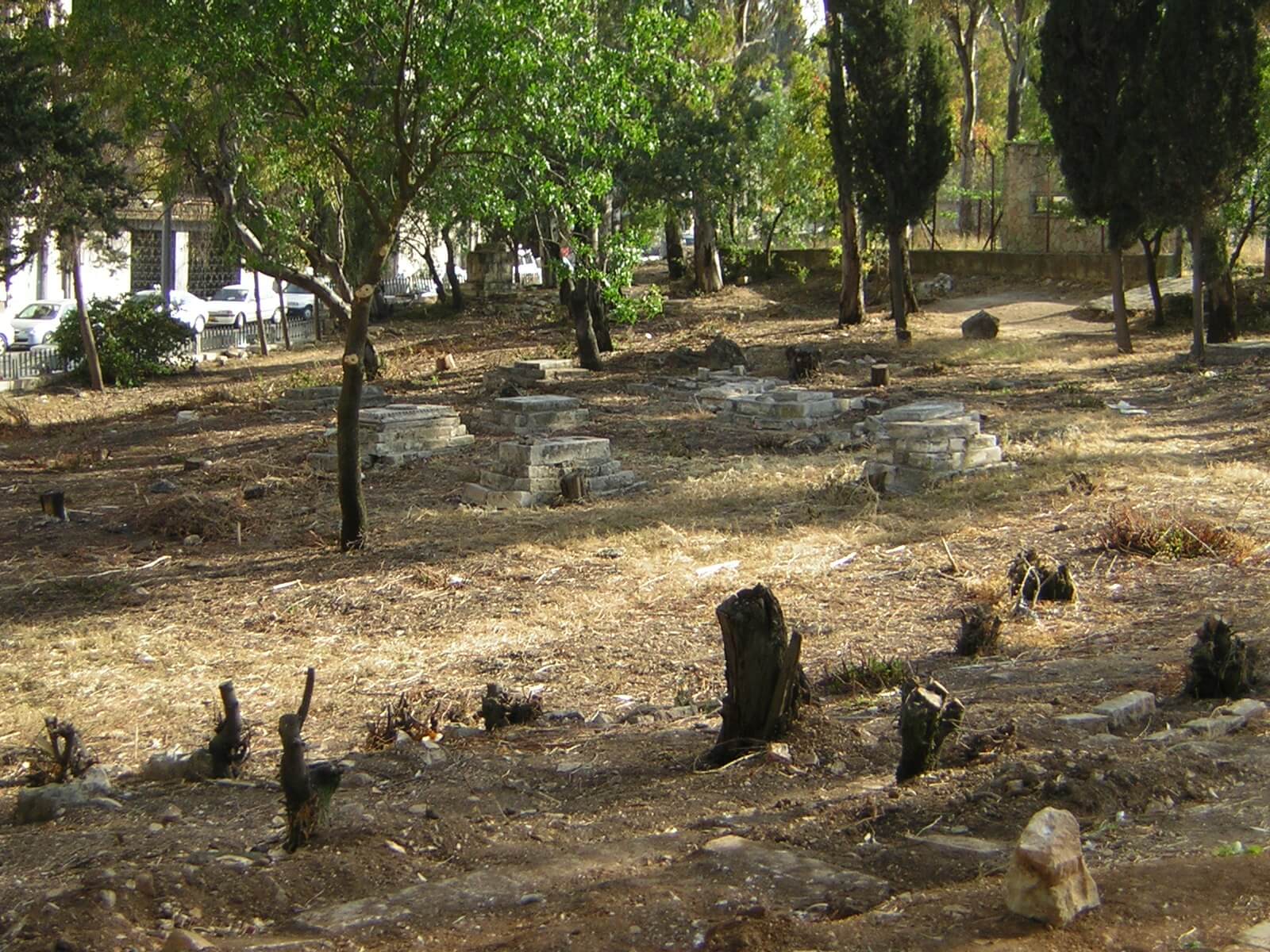
Mamilla Cemetery in a state of abandonment. © Tawfiq Daʿadli, 2006.
The last burial in Mamilla Cemetery occurred in 1927, when the Supreme Muslim Council – the body created by the British Mandate authorities to give political representation to Palestinian Muslims and administer waqf property – decided Mamilla was too crowded.
By this time, the area around Mamilla Cemetery, known as the Mamilla quarter, was densely built up with homes, offices and shops of both Arab and Jewish communities. British urban planner Henry Kendall drew up plans to entirely redevelop the cemetery area “for high class commercial and residential purposes.” While he claimed that “Many fine tombs which date back to the times of Saladin will be preserved and protected from further damage and neglect”, such a plan would have caused huge damage; thankfully, it existed only on paper.
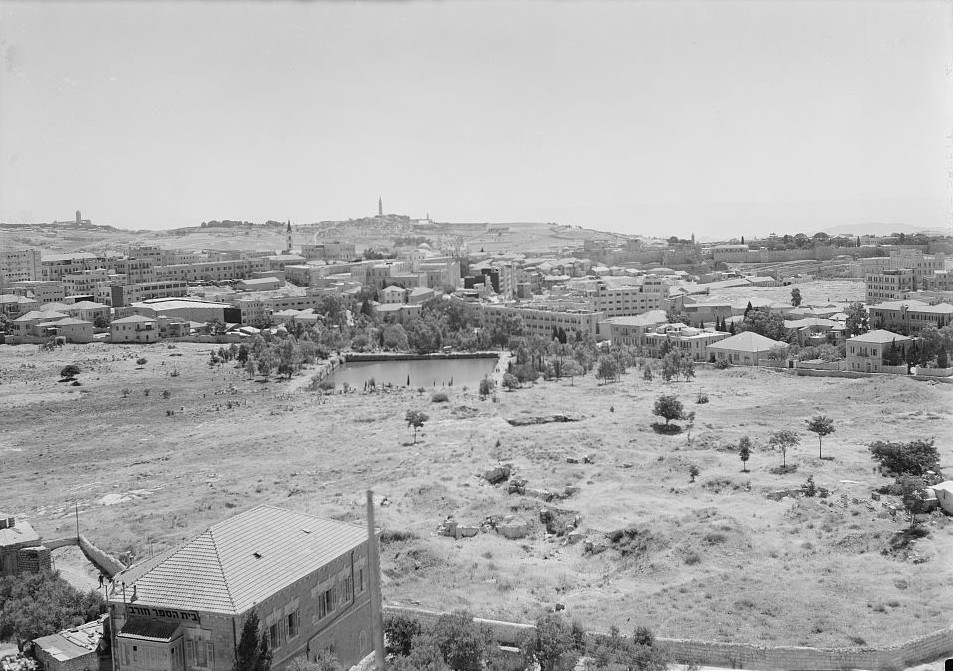
Urban development around Mamilla Cemetery in the 1920s, by American Colony Photo Department. Courtesy of the Library of Congress, Prints & Photographs Division. Courtesy of the Palestine Exploration Fund
The president of the Supreme Muslim Council, the Grand Mufti Hajj Amin al-Husayni, decided to build the Palace Hotel on part of the cemetery. Affected graves were moved, eliciting protests from Muslim Jerusalemites. The Palace Hotel, which opened in 1929, became the headquarters of the Peel Commission in 1936–37 where the decision to partition Palestine between Arab and Jewish states was taken; today, it is the Waldorf-Astoria Hotel, its original interior entirely remodelled.
In 1946, the Supreme Muslim Council carried out a survey of Mamilla Cemetery, counting 841 existing identifiable graves, with many hundreds of unmarked graves. The extent of the cemetery was 130 dunams, or 130,000 m2 – about 18 football pitches. In 1947, as the violence worsened across Palestine, the British temporarily turned the cemetery into a military camp.
Following the 1948 Nakba, Muslim Jerusalemites were no longer able to visit or maintain Mamilla Cemetery, just over the “Green Line” separating Israeli-administered West Jerusalem from Jordanian-administered East Jerusalem. As with all waqf property, and the property of Arab Palestinians who became refugees, Mamilla fell under Israel’s Absentee Property Law. Of this law, which expropriated sacred sites among other buildings, Palestinian poet Rashid Hussein (1936–77) bitterly exclaimed in his poem “Refugee God”:
God has become a refugee, Sir.
So:
Seize the prayer rugs from the mosque.
Sell the church, which now belongs to someone else.
Sell the muezzin on the black market.
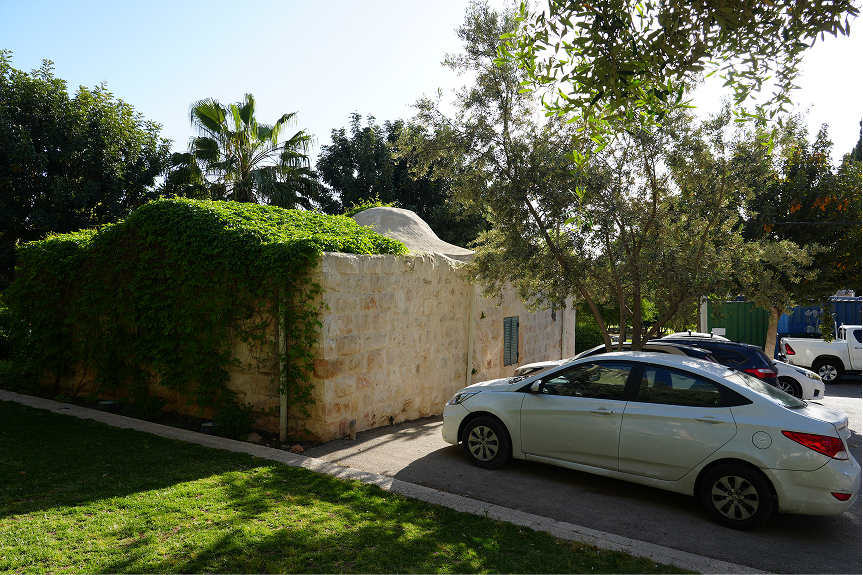
Dajani tomb. © Tawfiq Daʿadli, 2026
The Israeli authorities promised that Mamilla would be respected. However, the cemetery quickly became overgrown and dilapidated, and gradually shrank as a school and roads were built on parts of it, and pipes laid through it, destroying graves which were never catalogued. The gravestones and shrines themselves were disrespected. In addition to many of the grave markers being vandalised or destroyed, the cemetery caretaker kept chickens on the site in a coop constructed from tombstones in the 1950s, and in the 1980s, the Shaykh al-Dajani tomb was turned into a bar (the Dajani family finally regained control of the structure after a lawsuit in 2012).
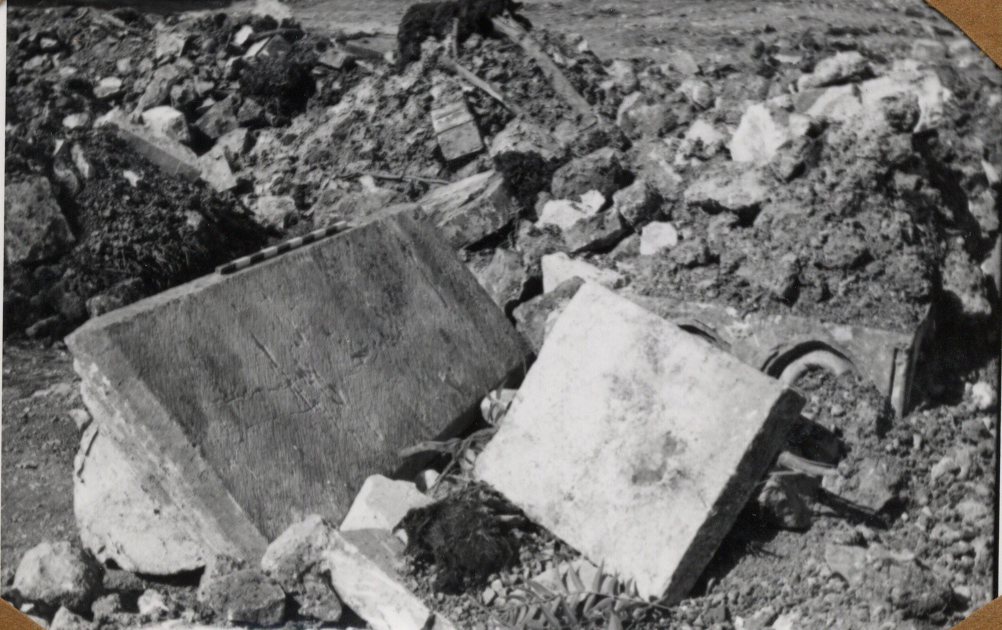
Broken and discarded tombstones in Mamilla in 1955. Courtesy of the Israel Antiquities Authority.
In the 1960s, the western part of Mamilla Cemetery was duly turned into Independence Park. Today, it is a peaceful green space for Israelis to relax, with only a handful of surviving Muslim tombs to indicate that their state’s independence meant Palestinians’ catastrophe. But the process of the erasure of Mamilla Cemetery was far from over.
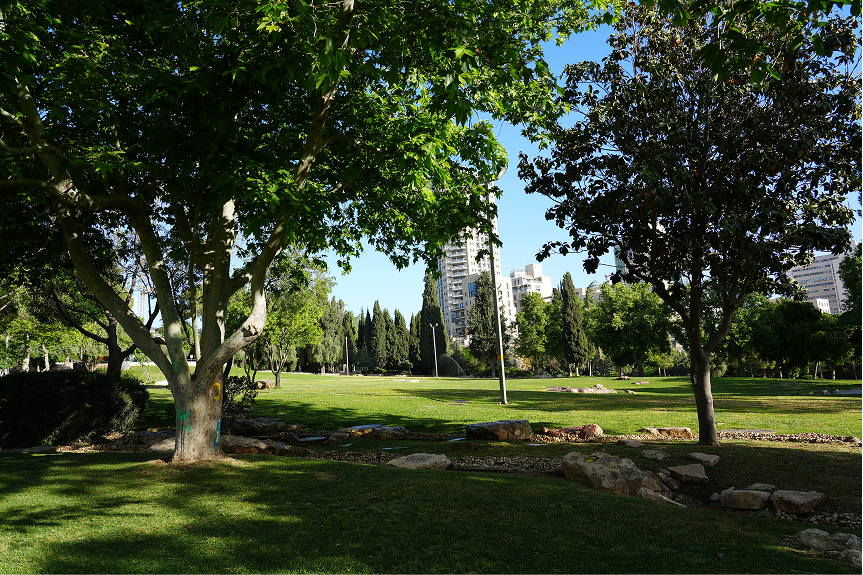
Independence Park over part of Mamilla Cemetery. © Tawfiq Daʿadli, 2026
In the 1990s, the Jerusalem Municipality announced plans to build a “Museum of Tolerance” on part of the cemetery, in conjunction with the Simon Wiesenthal Center, a Los Angeles-based pro-Israel advocacy organisation. In the 2000s, this led to a campaign to protect Mamilla Cemetery, which included local Palestinians, international activists and diplomats at the United Nations. Relatives of those buried there petitioned the Israeli courts to halt the works, but after deliberations and differing expert opinions, the decision was made to proceed, with the removal and destruction of graves.
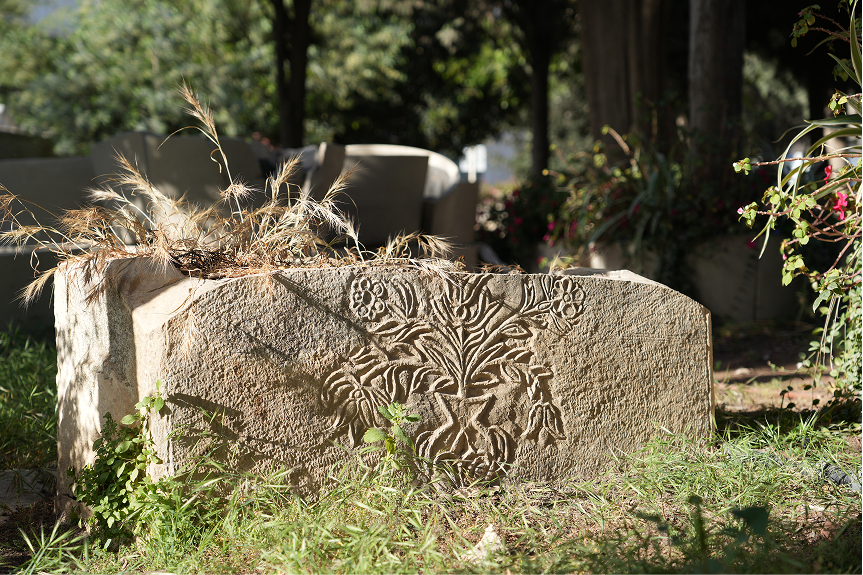
Damaged tombstone in Mamilla. © Tawfiq Daʿadli, 2026
A salvation excavation in 2005 uncovered over 1,000 Islamic and pre-Islamic graves. The Israel Antiquities Authority’s chief excavator Gideon Suleimani called for an end to the museum plan, which he called an “archaeological crime”; however, construction continued, with many unexcavated graves being dug up by bulldozers overnight, as documented in
this news clip from 2011. Palestinian-American academic Saree Makdisi poignantly wrote “It is little wonder that the white tents into which the skeletons now being removed from [Mamilla] are taken bear such a resemblance to the white tents that have been the hallmark of the Palestinian refugee”.
Centuries of burials, layer upon layer of Jerusalem’s dead, were disrupted and scattered. Upon these remains now stands a massive concrete structure – a monument, perhaps, not to tolerance but to erasure, a hollow tomb of its own, eternally marking the destruction of thousands who had chosen to rest in the soil of their sacred city, and who are there no more. With the losses of land to Independence Park and the Museum of Tolerance, only around 20 dunams of Mamilla Cemetery remain.
The stories of Mamilla Cemetery and al-Qaymuriyya are not unique. Hundreds of cemeteries vanished in the second half of the 20
th century. With the destruction of Palestinian villages after 1948, and the expulsion of their inhabitants beyond borders from which they could no longer return, the cemeteries became mere heaps of stones. Mamilla’s fate was, in a sense, better, despite the many violations of its sanctity. It stands in the heart of a living city, where people still pass by its graves. Many descendants of those buried there still remember their loved ones. These reflections are, in a way, an invitation to undertake another kind of
ziyara, like those of Mujir al-Din and many others, wandering again among the gravestones that, despite everything, still live on.
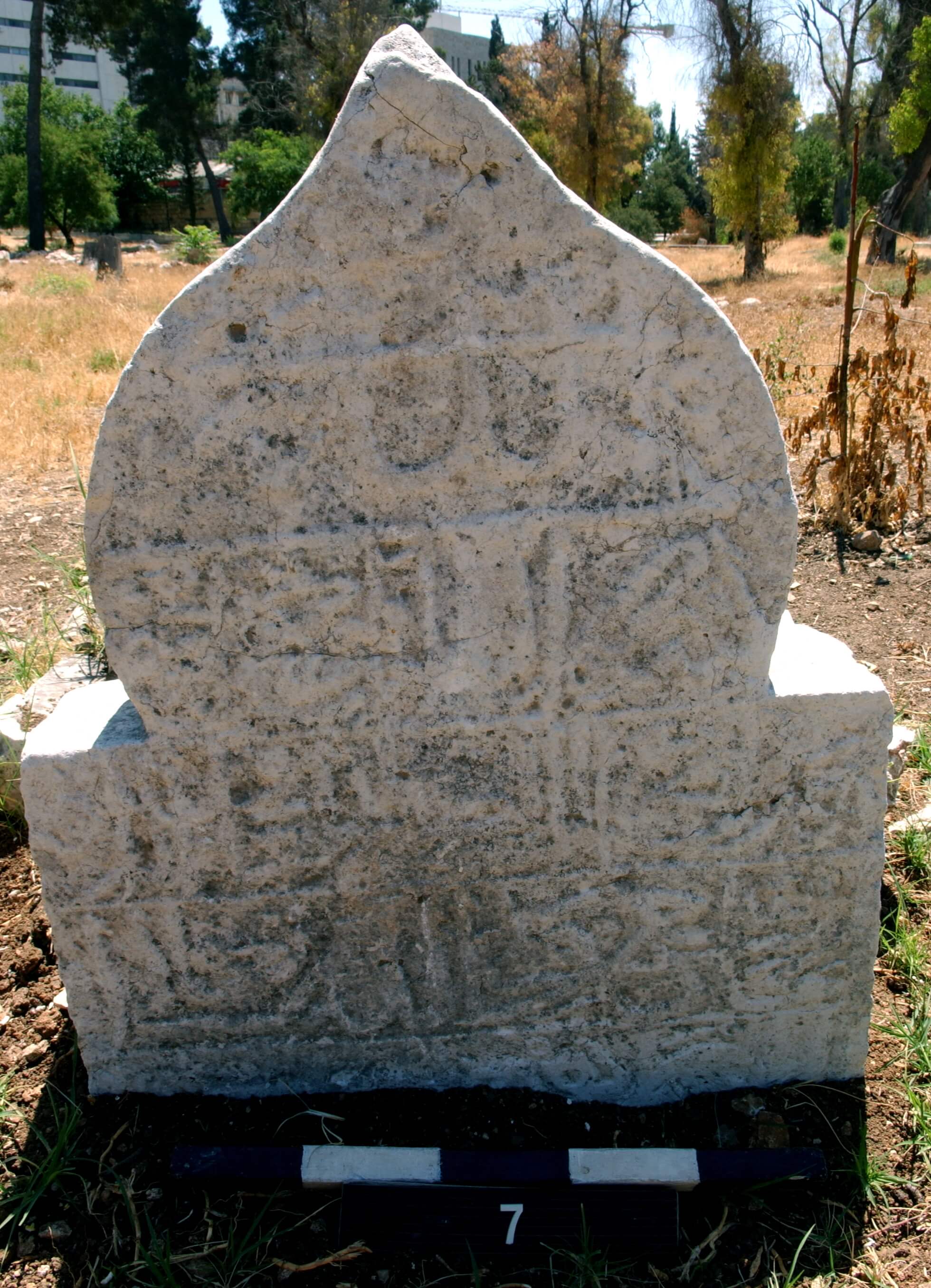
14th-century gravestone for an unknown person buried in Mamilla Cemetery. © Tawfiq Daʿadli, 2002.
Today, the surviving fragment of Mamilla Cemetery is in a dire state. Overgrown grass and bushes have left the area almost unrecognisable as a burying place of generations of Jerusalemites. Remaining tombstones are half-buried and interspersed with rubbish. A hoarding surrounds the cemetery, promising “history and heritage” in a redevelopment of Mamilla Pool. All traces of the surrounding tombs have been removed from the glossy artist’s impressions of the future of Mamilla.
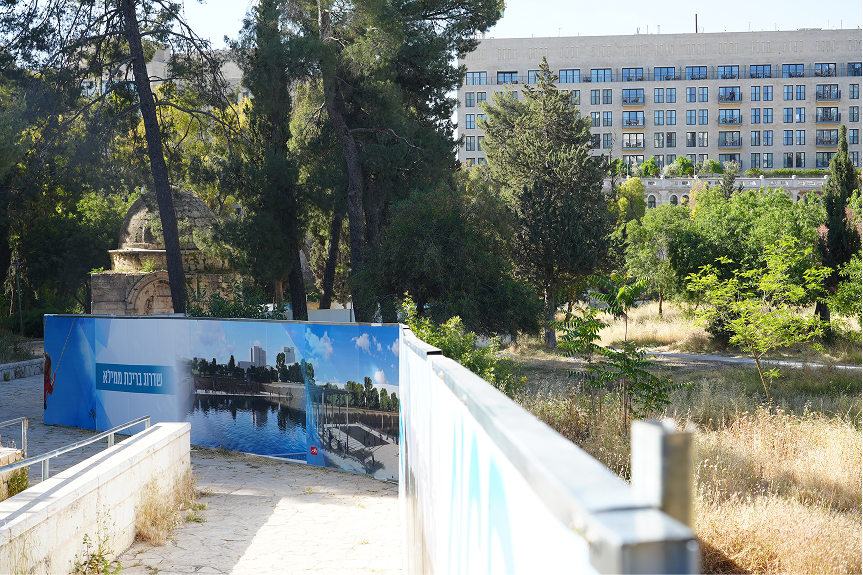
Hoarding showing planned redevelopment of Mamilla, near al-Kubakiyya. © Tawfiq Daʿadli, 2026