Click on the terms in blue for definitions and explanations.
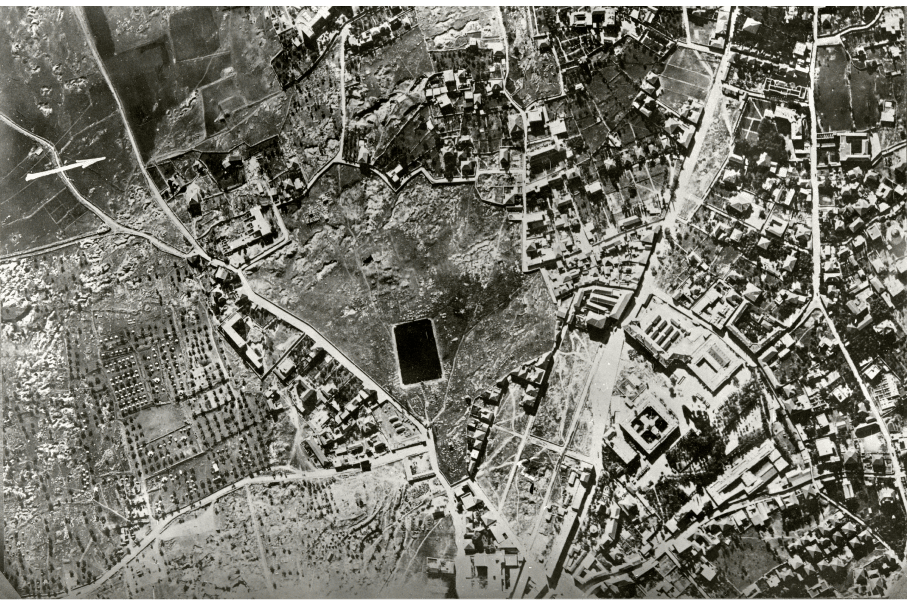
Aerial photograph of Mamilla Cemetery taken c. 1917. Courtesy of the Hebrew University of Jerusalem.
Imagine travelling to Jerusalem, between the 13th and 19th centuries. Perhaps you are a pilgrim to the city’s holy places, a merchant drawn by its bustling markets, or a farmer from a nearby village hoping to sell your produce. You approach from the west, aiming towards the site of the 16th-century Jaffa Gate, known in Arabic as Bab al-Khalil or “Hebron Gate”.
Where today there is the noise and rush of Jaffa Street and King George Street, before the late 19th and early 20th centuries, were only rocky hills. But arriving in Jerusalem, you must pass by – or even through – Mamilla Cemetery, a unique site where, for centuries, the city’s most distinguished and powerful Muslim men and women were laid to rest. Before encountering Jerusalem’s current residents, you make the acquaintance of its most eminent past inhabitants.
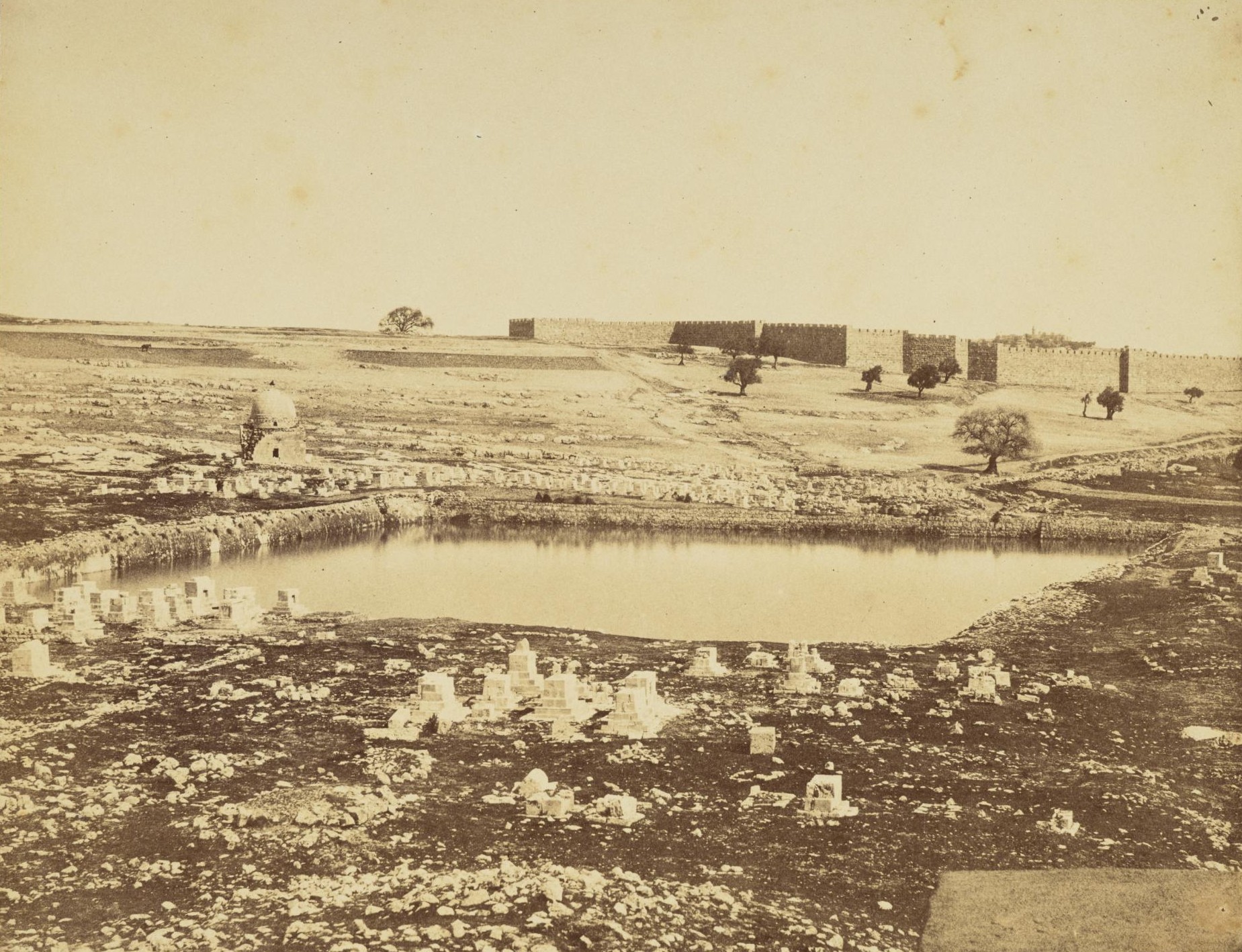
View of Mamilla Cemetery and the pool, by M.J. Diness, 1859. Courtesy of National Galleries of Scotland.
Mamilla is wrapped in legends. The origin of the name is unclear – possibly the Arabic ma min Allah, “that which is granted by God” or may min Allah, “water from God”. Another possible derivation, claimed by the 9th-century European pilgrim Bernard the Monk, comes from an otherwise forgotten Christian lady, Saint Mamilla, who may have had a Byzantine chapel on the site. Other names include Zaytun al-Milla (“Olives from God”), Bab Allah or Babilla (“Gate of God”) among Jerusalemite Christians, and Beit Millo among the city’s Jews. Many of the names reference the Almighty, demonstrating Mamilla’s deep holiness for centuries.
Mythology around the site predates Islam. A Christian legend tells how, after the attack on Jerusalem by Persian forces under Khusrow II in 614 CE, a mysterious woman and a lion carried the bodies of 12,000 Byzantine martyrs to an ancient water cistern carved in the rock in Mamilla. Similar stories were told by Jews about the dead during the Maccabean Revolt in the 2nd century BCE, and by Muslims about those slaughtered by the Crusaders in 1099. Colourful stories continued to be told about Mamilla throughout the Islamic period. One held that somewhere within the cemetery lived an enchanted plant with legs, which could move around at will.
In the east of the cemetery can be found one of the city’s largest ancient water reservoirs: the Mamilla Pool. This immense rainwater cistern, about 60 × 100 metres in size, with a capacity of 36,000 m3, once supplied water to the city. Since all Jerusalem’s natural water sources lay outside its walls, this was crucial for sustaining life within the city. The pool was also an important natural habitat, with a unique species of tree frog discovered in 1997, which has since become extinct due to increased urbanisation and hotter, drier conditions. Around the pool were hundreds of graves, the water reflecting both death and the natural life of the cemetery.
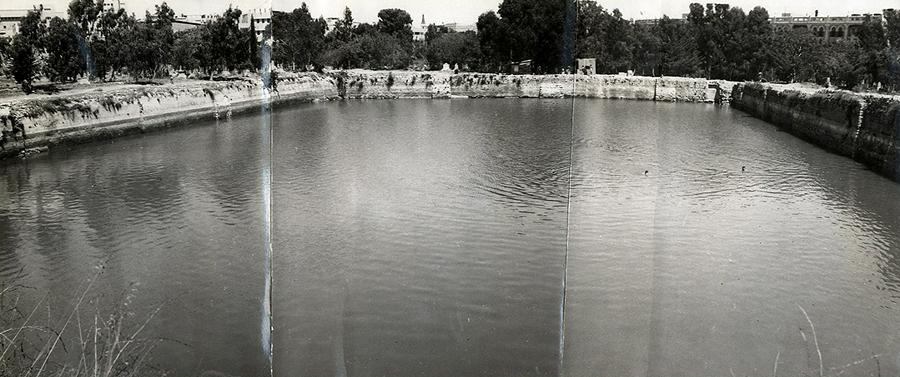
Israelis swim in Mamilla pool in the 1950s. Courtesy of the Israel Antiquities Authority.
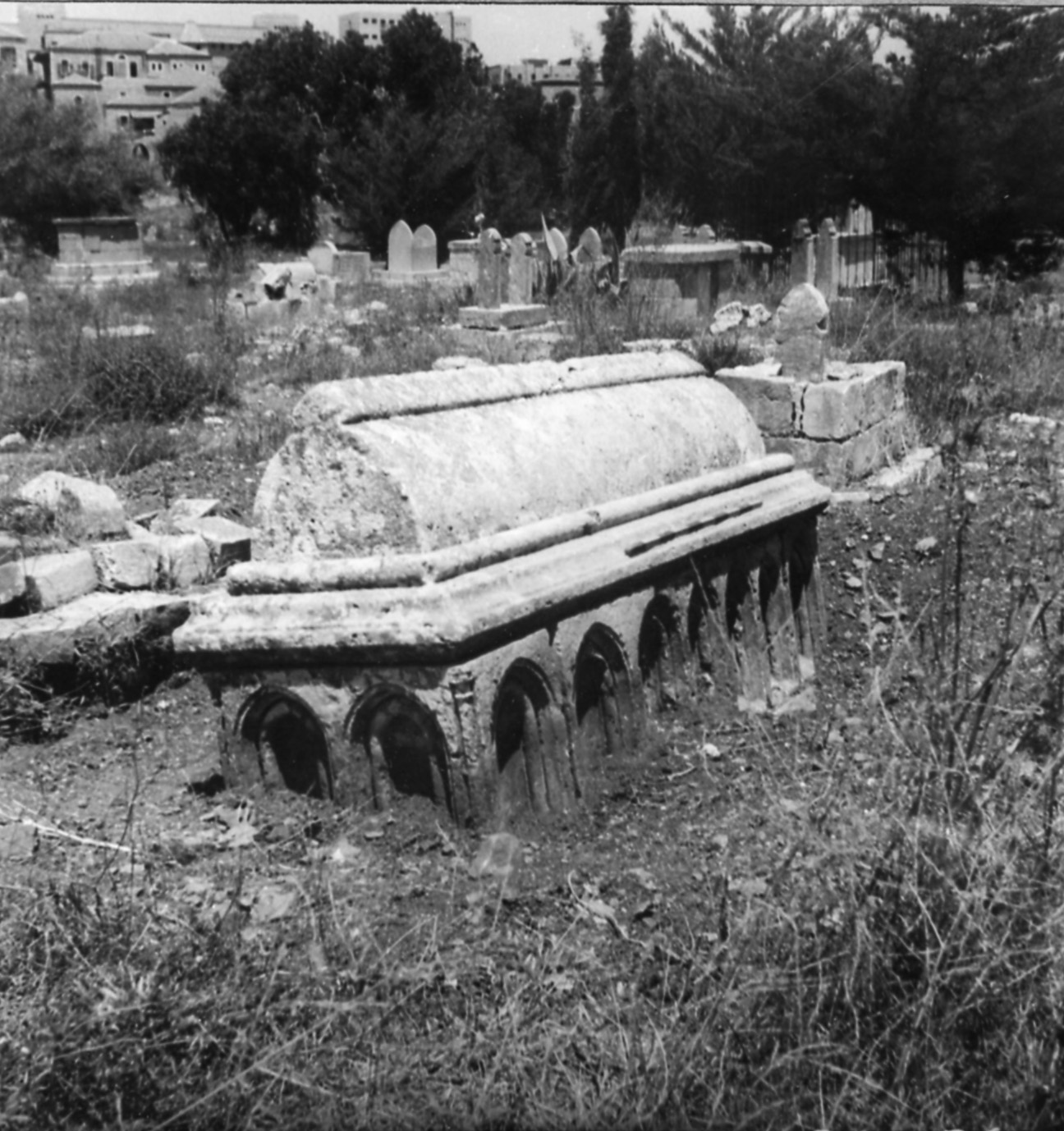
Burials in Mamilla Cemetery may have begun in the early Byzantine period; by the 8th century, according to Mujir al-Din, Mamilla was already a place of burial for eminent Muslim scholars. During the Crusader occupation of Jerusalem, in the 12th century, Christian burials may have resumed in Mamilla. Several graves in Mamilla may be of European origin, and may date to this time – or they could be Christian grave markers reused for Muslim burials, or imitations of Crusader stonework made by local Muslims for Muslim tombs.
A possible Crusader-era tomb in Mamilla, surrounded by Islamic graves in the 1950s. Courtesy of the Israel Antiquities Authority.
Mamilla was Jerusalem’s most prestigious graveyard, with one commentator vividly asserting that “burial in it is like burial in Heaven.” We also know from historic records that purchasing a plot in Mamilla was more expensive than in the city’s other Islamic cemeteries, and thus accessible only to the elite. Burial practices often reflect a person’s social standing: ways of burial mirror the living city within the cemetery.
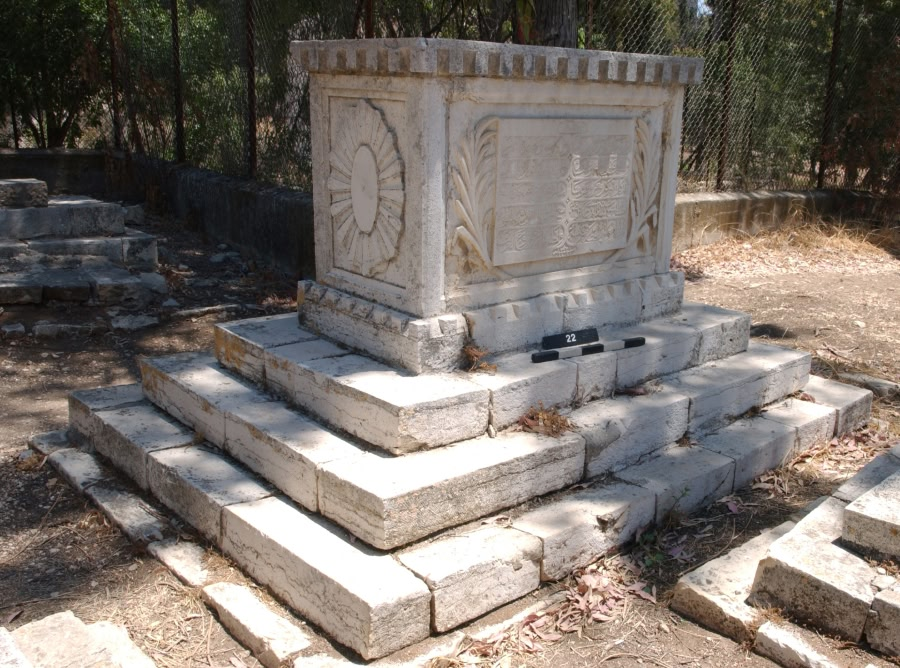
The grave of Hasan al-Nashashibi, a wealthy merchant from one of Jerusalem’s most powerful families, laid to rest in Mamilla towards the end of Ottoman rule in 1903. © Tawfiq Daʿadli, 2002.
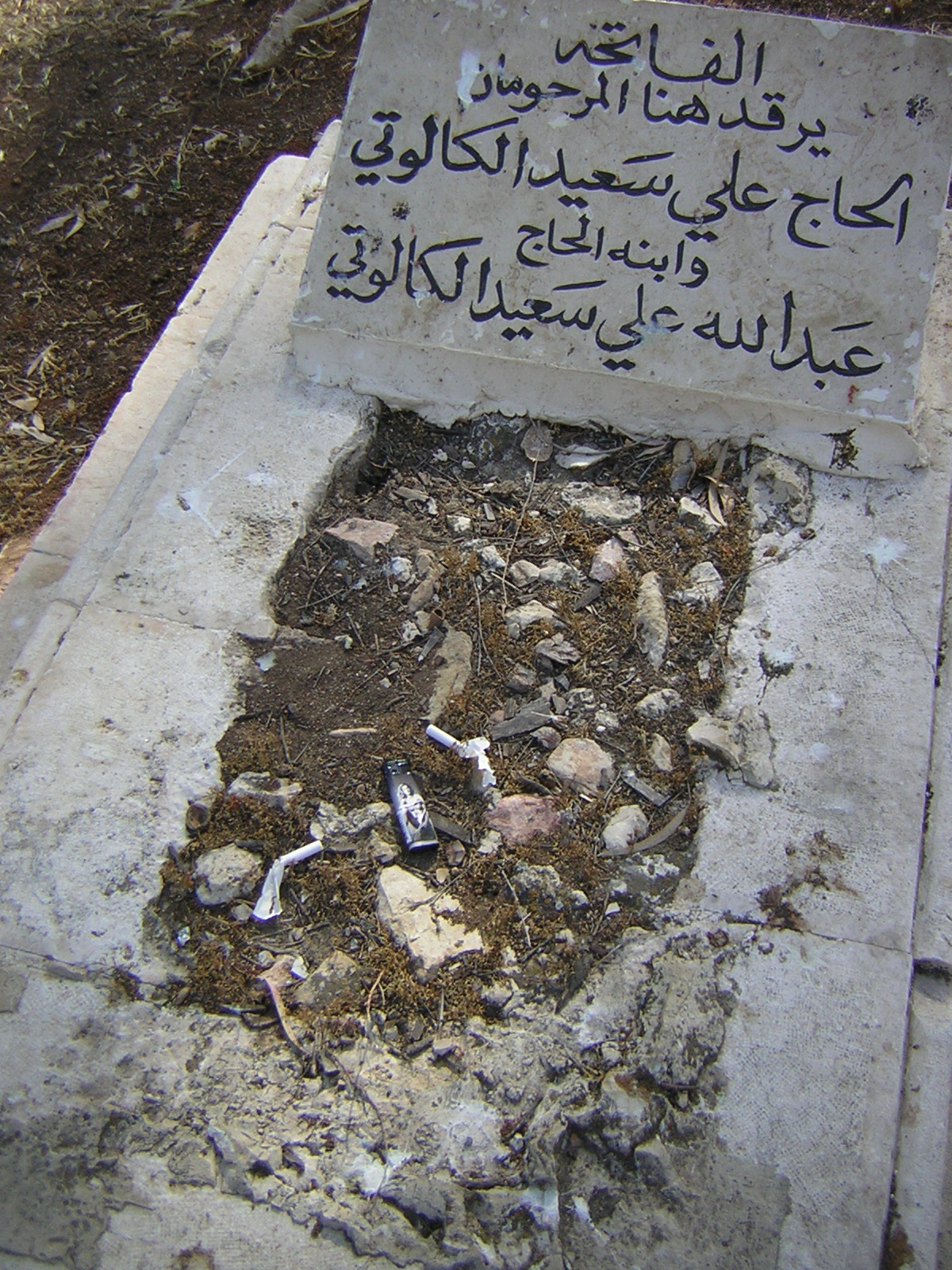
Until 1948, Mamilla Cemetery was well kept, with family members of those interned there regularly visiting and maintaining the graves, from centuries-old limestone slabs to the gleaming marble of late 19th- and early 20th-century Ottoman tombs. These visits of the living gave the city of the dead its vitality. But once that bond between the dead and their living relatives was broken, the cemetery began to decline. Following the creation of Israel, gravestones were gradually buried, broken or destroyed, to make way for roads, sewage pipes and a park commemorating the establishment of the State of Israel. Then came a colossal project, the Tolerance Museum, that laid a massive concrete block over a large portion of the burial ground.
This platform seeks to combine the political dimension of Mamilla’s story since 1948 with the story of the many generations of Palestinians and Muslim pilgrims who have been laid to rest in Mamilla, many famous across the Islamic world in their day and for centuries after. Restoring these past Jerusalemites to their rightful place at the heart of this story, we focus on graves from the early Mamluk era, the 13th and 14th centuries.
We also include the al-Qaymuriyya tomb not far from Mamilla, which has undergone a striking transformation in recent years, illustrating the fates of Palestinian heritage sites in Israel.
Late 19th- or early 20th-century grave of al-Hajj ʿAli Saʿid al-Kaluti and his son ʿAbdullah, showing the neglected state of many of the graves. © Tawfiq Daʿadli, 2006.
To better imagine Mamilla Cemetery in its glory days, we rely on guides from the past. Earliest among these is Mujir al-Din al-ʿUlaymi. Born in 1456 in the Palestinian city of Ramla, he served as the Islamic judge or qadi in Jerusalem (another name of Mujir al-Din is al-Hanbali, after the school of Sunni Islam to which he adhered). His most important surviving work is Al-Uns al-Jalil bi-Tarikh al-Quds wal-Khalil, “The Glorious History of Jerusalem and Hebron”. Writing about Mamilla, Mujir al-Din takes his readers on a ziyara, a visit to figures who had attained sanctity over the years. He describes what he sees, but also looks back in time, recounting traditions preserved in writing and oral memory. In a similar manner, we stand in the present, visiting the remains of those still buried beneath the ground, while also recalling the tombs no longer in place.
A more recent guide is Hamdi Nubani, a dedicated scholar of Palestine’s Arab and earlier history. Nubani served as a British Mandate Inspector of Antiquities in the 1940s, and subsequently secretary of the Palestine Archaeological Museum (renamed the Rockefeller Museum in 1967, and as of 2026, facing an uncertain future). Nubani’s photographs of many Mamilla tombs taken in the 1940s are today invaluable for reconstructing the cemetery as it was before many of the graves were vandalised, moved at random or destroyed.
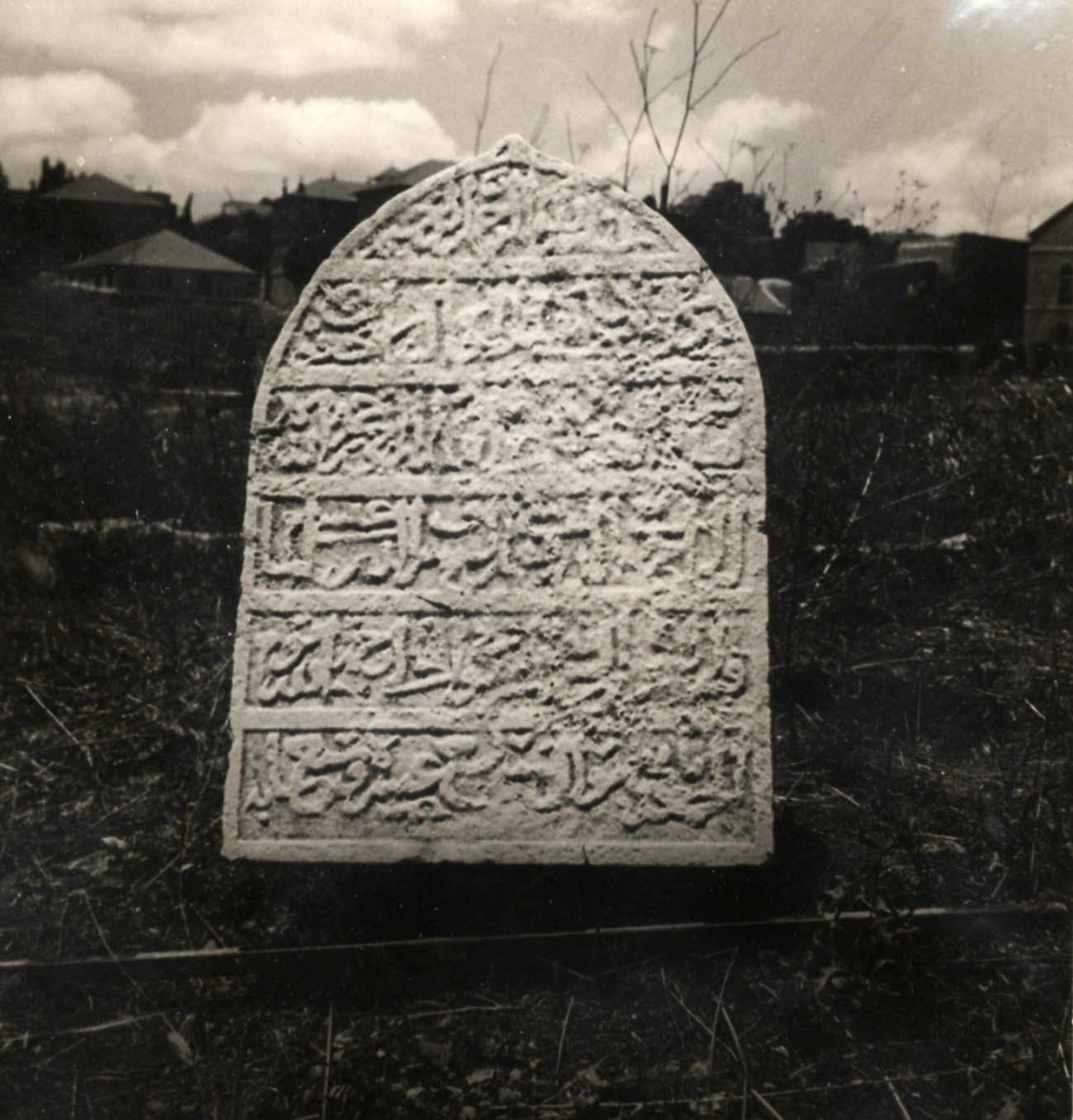
The tombstone of Sharaf al-Din ʿIsa, possibly the imam of al-Aqsa Mosque in the 14th century, died 1314 or 1319, now moved within the cemetery, photographed by Hamdi Nubani in 1946. Courtesy of the Israel Antiquities Authority.
Most tombs profiled by PHJ are of travellers from around the Muslim world, from Islamic Spain to Central Asia, who were drawn to Jerusalem for different reasons, from political appointments to the allure of studying in a famous centre of religious knowledge. Many local Palestinians were also buried in Mamilla, including possibly Mujir al-Din himself. But if it did exist in Mamilla, his grave, like so many others, has been lost either to time, modern urban development or deliberate neglect by Israeli authorities.
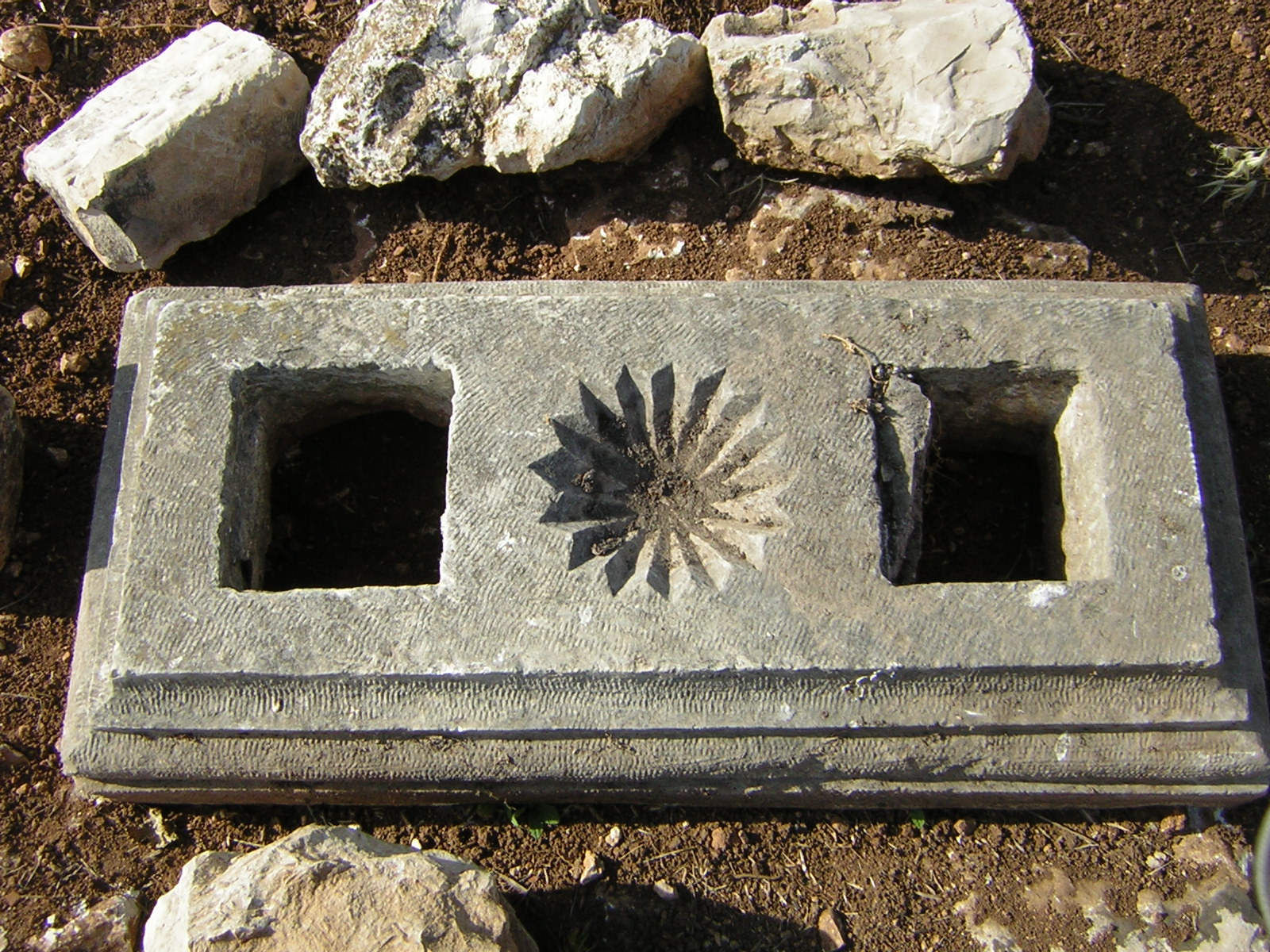
A damaged fragment of a tomb, with holes for decorative columns, now missing, and an indentation possibly to collect water for birds and animals. © Tawfiq Daʿadli, 2006.